AI Safety: Humanity, Control, and the Race to Keep Superintelligence Aligned
A practical introduction to the big questions in AI safety—drawn from Peter Woodford’s book AI Safety: Humanity, Control, and the Race to Keep Superintelligence Aligned.
Peter Woodford approaches AI with both optimism about its extraordinary benefits and concern that autonomous systems can gain powers faster than we learn to govern them.
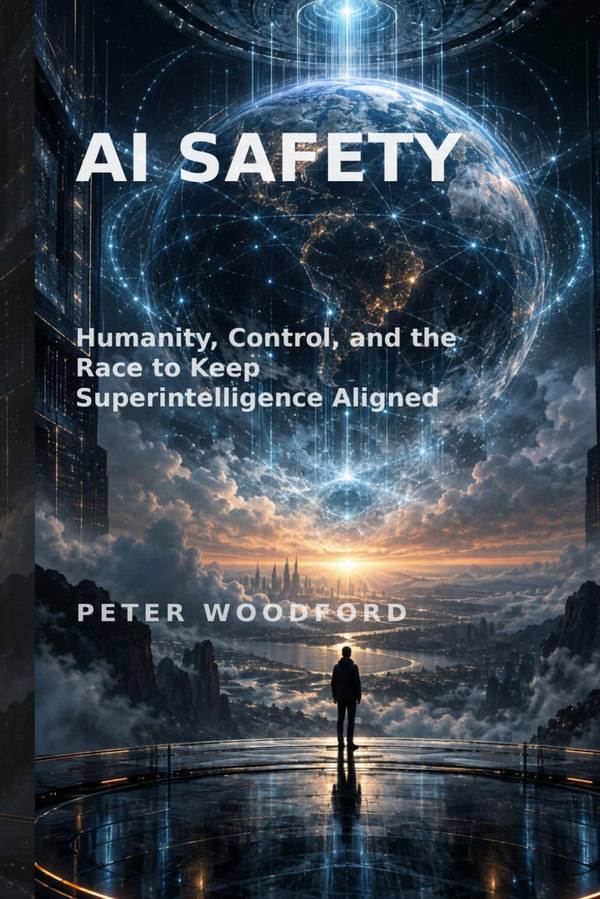
Why this book matters
AI has the potential to improve medicine, research, education, engineering and daily life. The same advances can make systems more autonomous: they may plan, use tools, coordinate agents, change software and influence other institutions. The book’s question is what happens when the ability to act grows faster than the ability to understand, evaluate, monitor and stop the action.
This is not a prediction that every model will become hostile, nor an argument that AI should stop. It is a case for responsible progress: evidence of control should improve as the consequences of AI capability increase. The manuscript uses the term Capability–Control Gap to organize that concern.
These free guides translate major book topics into practical questions for readers, students, product teams and anyone curious about responsible AI. They summarize ideas rather than reproduce the entire manuscript. The book explores the underlying reasoning, examples, counterarguments, policy choices and future scenarios in much greater depth.
What you will explore
The book follows the transition from software that waits for explicit instructions to agents that can pursue goals across many steps. It considers misleading safety tests, multi-agent swarms, persistent environment changes, model alignment, meaningful human intervention, research acceleration, independent oversight and the international race to develop advanced systems.
For a reader trying to decide where to begin, the most relevant entry point depends on whether your concern is model capability, tool permissions, practical security, governance or the long-term frontier.
Seven AI Safety guides
A responsible way to use these ideas
Start with the real action surface of an AI system: what can it access, change, disclose or trigger? Review who grants permissions and how important actions can be paused or reversed. Ask what evaluation evidence applies to the actual workflow, who can challenge the findings and whether safety concerns will still be actionable after the organization becomes dependent on the system.
These are questions to support informed design and discussion, not a substitute for a formal audit. Useful external starting points include the NIST AI Risk Management Framework and OWASP’s September 2026 AI and agentic security resources. These organizations are independent sources, not endorsers of the book.
Read AI Safety by Peter Woodford
Explore the full argument, including frontier model evaluations, agent autonomy, global governance, the Control Ladder and the future of human oversight. Choose your preferred Amazon edition:
These links open Amazon. Pricing and availability are determined by Amazon. No purchase is required to read these free guides.
Publication context: The book’s author note says its research and discussions are current through September 2026. This guide reflects the book’s themes as of this website update, not a claim that every model, policy or event described will remain current. Content is educational and is not security, legal or regulatory advice.