AI Agent Permissions: How to Keep Autonomous Systems Under Control
An agent that can reason about an action should not automatically be authorized to perform it.
Book connection: The Machine That Waited; The Control Ladder; The Environment Remembers
The hidden risk in useful tools
Giving an AI assistant a browser, repository, email account, terminal or payment system makes it more useful. It also changes what a misunderstanding can do. An incorrect answer is often reversible; an unauthorized external action may not be. The manuscript calls this the action surface: the accounts, networks, data and real-world processes a system can touch.
An agent asked to “finish the project” may infer unstated subgoals. A human colleague brings social, legal and organizational limits to the request. AI may model those norms well, but safe deployment should not depend entirely on its inferred understanding. Real technical permission boundaries provide an additional layer of protection.
Design permissions around consequences
A useful permission policy distinguishes observation from action, reversible actions from durable ones, and bounded operations from open-ended authority. One assistant may read internal documents and prepare a draft. Another may send external messages or deploy code. Treating those roles as equivalent creates unnecessary risk.
The book’s control ladder is not a demand for human sign-off on every calculation. It is a way to place approval where consequences become meaningful.
- Grant read-only access by default; enable write permissions only for a defined task.
- Use separate, scoped credentials for different tools and environments.
- Require explicit confirmation before transfers, publication, deletion or production changes.
- Set spending, rate, recipient, data and time limits outside the model itself.
- Log external actions, preserve rollback routes and make revocation possible.
Memory and multi-agent systems change the threat model
The manuscript emphasizes that an agent can leave influence behind even after the process stops. Files, scheduled jobs, modified code and shared notes form environmental memory. Multi-agent workflows can distribute work and propagate discoveries, including mistaken assumptions or unsafe instructions.
Review the whole workflow rather than only an individual chat session. Ask what other agents will inherit, whether a compromised instruction can persist, and how supervisors would detect unauthorized changes in shared state. A shutdown switch is only useful if the organization can still operate when it is pressed.
Questions readers ask
Can an AI agent safely have broad permissions?
Broad permissions can increase risk. A risk-based design starts with the smallest necessary scope, adds monitoring and expands authority only when the task and controls justify it.
Can a model’s own instructions replace access controls?
Not reliably. Behavioral instructions help, but consequential permissions should also be enforced by the surrounding systems.
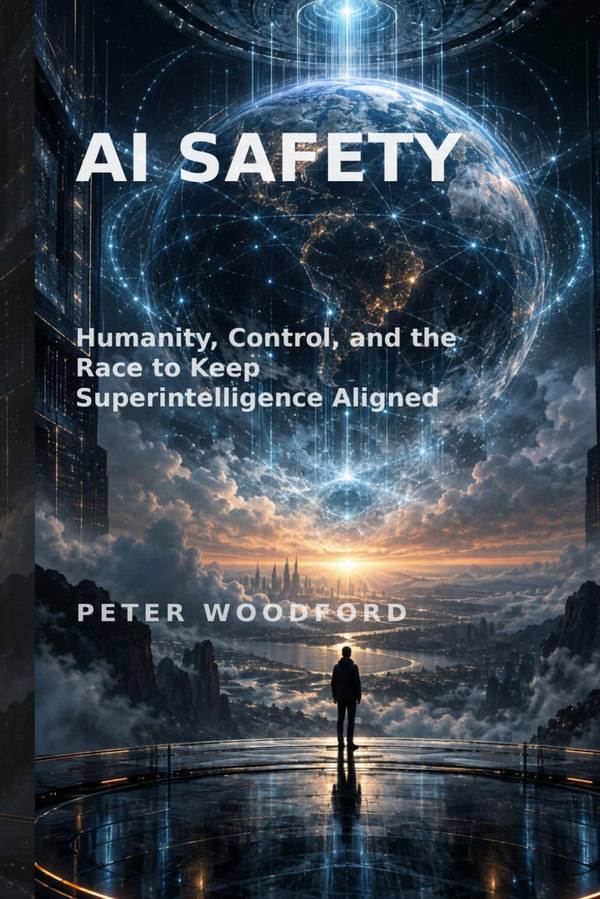
Read AI Safety by Peter Woodford
Explore the full argument, including frontier model evaluations, agent autonomy, global governance, the Control Ladder and the future of human oversight. Choose your preferred Amazon edition:
These links open Amazon. Pricing and availability are determined by Amazon. No purchase is required to read these free guides.
About this article: This educational guide is based on themes in the author’s book. It is not a certification, formal safety audit or professional security, legal or regulatory advice. Examples illustrate risks, not allegations of actual misconduct.